

Imagine discovering that one of your best customers spends three times as much money with your competitors as they spend with you.
They’ve been a loyal customer for years. They appreciate your work, pay their bills, and regularly come back for more. From your perspective, it’s a successful relationship.
But you’ve only been getting a portion of their business.
For an established business looking to grow, that’s an interesting possibility. How much additional revenue could come from customers who already know and trust the business?
Your $50,000 Customer May Be Spending $200,000
Consider a company that supplies promotional products to other businesses.
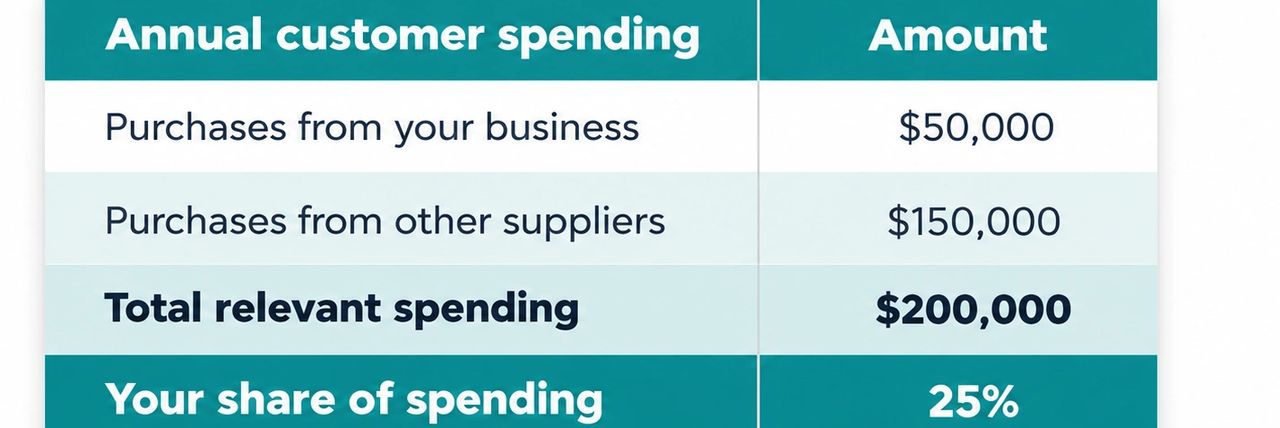
One of its customers spends $50,000 annually on branded merchandise. It’s a healthy account, with consistent purchases and a good working relationship.
But that same customer purchases another $150,000 in employee uniforms, printed materials, trade show displays, and corporate gifts from other suppliers.
The supplier is capturing just 25% of the customer’s spending in categories it could potentially serve.
There may be perfectly good reasons for that. Other providers may have longstanding relationships or specialized capabilities. The customer may not know the supplier offers those products. Or the relationship may have begun with one particular need and simply stayed there.
Nothing is necessarily wrong with the relationship. The supplier may simply be seeing a much smaller opportunity than the one that exists.
You Know the Customer. But Do You Know All the Buyers?
During a conversation about an upcoming employee event, the supplier’s marketing contact mentions that:
- HR is coordinating uniforms for new employees.
- Operations is ordering printed materials for several locations.
- The events team is working with another vendor on trade show displays.
Three departments. Three purchasing relationships the supplier didn’t know existed.
The supplier has worked with this company for years, but its relationship is effectively with one department.
Each department has its own budget, priorities, and preferred suppliers. And the marketing contact may have little involvement in what those other departments purchase.
The same situation can occur in service businesses. A professional services firm may work closely with a company’s finance department without realizing that HR or operations is purchasing related services elsewhere.
A longstanding relationship with an organization doesn’t necessarily mean a business is serving the whole organization.
What Else Does the Customer Need?
In conversations with those departments, the supplier learns that coordinating branded merchandise across multiple locations has become a headache.
Marketing wants consistent branding. HR needs uniforms for new employees. Operations wants reliable delivery to different locations.
Each department has found suppliers that meet its individual needs. But someone still has to:
- Locate approved artwork and product specifications.
- Coordinate orders across different vendors.
- Track inventory and delivery schedules.
- Resolve fulfillment issues when something goes wrong.
And much of that work gets repeated across departments.
The supplier could approach each buyer with its existing product catalog and compete for additional orders.
But what if the bigger opportunity is solving the problem behind those purchases?
Perhaps the supplier could create a managed company store where employees across departments and locations order approved merchandise, uniforms, and printed materials through a single system.
Purchasing becomes easier. Branding stays consistent. Fulfillment is coordinated through one provider. The products themselves might not be new. But the service surrounding them would be.
The supplier didn’t discover that opportunity by reviewing its sales reports. It emerged from understanding how the customer manages purchases beyond the supplier’s existing relationship.
Sometimes the Opportunity Is Something You Don’t Offer Yet
Consider a professional services firm that develops strategies for its clients.
The firm delivers its recommendations, the client agrees with the direction, and the engagement ends.
Months later, the client hasn’t made much progress.
At first, that may seem like an ordinary implementation challenge. The firm completed its work, and the client is responsible for what happens next.
But suppose the same issue keeps coming up:
- Some clients lack the people or expertise to implement the recommendations.
- Others struggle to coordinate the work across departments.
- Several need ongoing guidance as priorities and circumstances change.
Over time, those conversations may reveal demand for implementation support, ongoing advisory services, or a partnership with another provider.
The opportunity was there all along, but it sat just beyond the work the firm was hired to perform.
And it raises an interesting question: What are your customers struggling with before, during, or after they buy from you?
One Customer’s Problem. A Bigger Market Opportunity.
Back to the promotional products supplier.
What started as a conversation about an employee event has revealed other buyers, additional purchasing activity, and a problem coordinating merchandise across departments.
Now suppose the supplier asks a few other customers how they handle similar purchases.
Some are happy with their arrangements. Others describe familiar frustrations with multiple vendors, inconsistent ordering processes, and coordinating deliveries.
The managed company-store idea begins to look less like a solution for one customer and more like a service several customers might value.
A conversation with one customer has revealed the possibility of an entirely new offering.
Now consider a $5 million business looking for its next $1 million in revenue.
It may need new customers to reach that goal. But how well does it understand the customers it already has?
- What products and services are they purchasing from other providers?
- Who else within those organizations makes purchasing decisions?
- What problems are they dealing with that the business doesn’t currently solve?
The company’s sales reports can tell it how much revenue those relationships generate today. They can’t tell it everything those customers might need tomorrow.
Some of the revenue the business is looking for may already be in its customers’ budgets. It’s simply going somewhere else.